100 Days Project, Soups

Day 16 – Vegetarian French Onion Soup

Day16

Thank you for your patience Herbivores . . .

I was away up North Saturday night at a friend’s bach (hoilday house), for a quick little get away. I came back on Sunday, but ended up having to take a friend to the hospital and spent most of the night in the A&E. I promise normal posting will returning this week.

Even though I have not been posting I have still been cooking for my 100 Days Project, and going away with friends is the perfect opportunity to cook up a big group meal and try out some new recipes on the unsuspecting eaters.

French Onion Soup is winter classic, but it gains much of it’s traditional flavor from the use of beef stock making the soup not very vegetarian friendly.  I have always been curious about what this soup tastes like, especially since it is normally served in a bowl topped with gooey cheese melted across a bread layer. Anything with melted cheese on it usually gets my attention. So . . . when I came across this recipe from the amazing Jerry James Stone that promised to deliver on the flavor by using coffee to help give the soup a hearty earthy flavor vegetarian versions are normally missing, I have to admit I was intrigued.

Needless to say my meat eating friends were dubious when I told them I was making a soup with coffee in it, but all in all this version of French Onion Soup got the meat eaters thumbs up seal of approval.

French Onion Soup

adapted from: Jerry James Stone

INGREDIENTS

  • 4 large red onions, thinly sliced
  • 8 cups mushroom stock (1 teaspoon of stock powder per cup of water)
  • 1 cup strong brewed coffee
  • 1/4 cup dry white wine
  • 1 teaspoon fresh thyme
  • 1 teaspoon of sugar
  • Olive oil
  • Bread slices (I used a whole wheat sourdough)
  • Sliced cheese (Emmentaler or Swiss)
  • Salt and pepper to taste

In a large stock pot, add the thinly sliced onions and some olive oil. You want just enough olive oil to lightly coat them.

Turn the heat to medium-high and cook the onions down, caramelizing them. Only stir them every five minutes. If they begin to burn instead of caramelizing, reduce the heat a bit. Caramelizing onions is really a balancing act between your burner and the quality of your stock pot.

Once the onions have been reduced, add the mushroom stock.

Add the thyme, white wine and sugar. Bring the mixture to a very low simmer and cook covered for about three hours, stirring occasionally.

While that simmers, brew a single cup of your favorite coffee. Add the cup of coffee to the soup in small batches, stir well and taste. You don’t want your soup to taste like coffee, you just want to enhance the flavor. Depending on how strong you brew yours, you might not use a full cup. Then salt and pepper the soup to taste.

For each serving, fill a ramekin or small bowl with a heaping amount of soup and place it in the large baking dish. You’ll need one bread slice for every serving, and place the bread on top of each filled ramekin or small bowl. Top with a slice of cheese or two (you can never have enough melted cheese).

Place the baking dish under the broiler for a few minutes just until cheese is melty and starting to brown.

ENJOY!!
Standard
100 Days Project, Dairy Free, Gluten Free, Recipes, Side Dish, Vegan

Day 15 – Horseradish Potato Salad

Day15

Summer or Winter, it is always a good time to make potato salad.

It makes the perfect accompaniment for the summertime BBQs, and a hearty side dish for meals on those cold winter nights. Usually potato salad is made with cream, sour cream or mayonnaise, so I was really excited to find this vegan version that can be made for everyone to enjoy. This recipe from Karina: The Gluten Free Goddess uses olive oil and apple cider vinegar in place of the mayonnaise dressing.

Horseradish, which is a spicy root vegetable closely related to mustard, wasabi, broccoli, and cabbage, is the main flavor element of this recipe.  I surprisingly found this ingredient (either fresh or prepared) vary hard to find in New Zealand. If you can only find it fresh make sure to process it into a paste in a food processor adding a slight bit of water and white vinegar, or else it will go brown. I finally found a prepared version at Farro Fresh, a high-end Auckland based food market. If you live outside of Auckland, you should be able to find it at a similar type of store. Make sure not to get a prepared version that has dairy mixed in, it should only have water , salt, or vinegar.

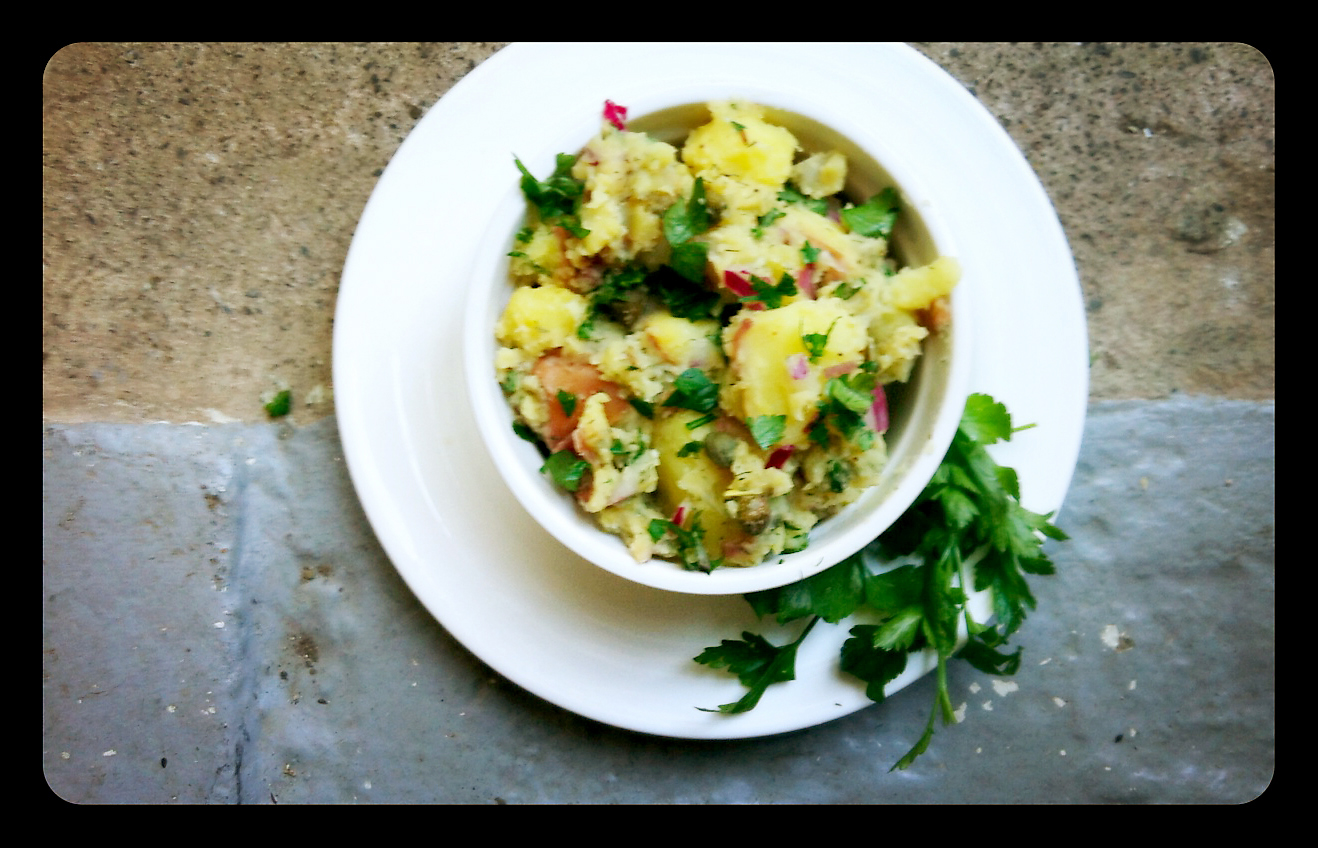
Usually, I like to add pickles to my potato salad, but that did not quite seem to be the right thing to go with the flavors in this recipe. So I had a quick look in the fridge and came up with the perfect solution, Capers!!! These added the perfect little pop of salty goodness.

This potato salad recipe turned out so full of flavor, and made a perfect side dish to go with the left over Lentil and Chickpea Sliders from my Day 14 post.

Horseradish Potato Salad

adapted from: The Gluten Free Goddess

INGREDIENTS:

  • 2 pounds or 1 kg small red potatoes
  • Sea salt
  • 1/4 cup fruity tasting extra virgin olive oil, as needed
  • 5 tablespoons apple cider
  • 1 smallish red onion, finely diced
  • 2 tablespoons prepared horseradish
  • Sea salt and fresh ground black pepper
  • 2 tablespoons chopped fresh parsley
  • 2 teaspoons dill, to taste
  • 1 teaspoon caraway seeds
  • 2 tablespoons capers

Wash and cut up the red potatoes, toss them into a pot of salted fresh water. Bring the water to a boil and simmer the potatoes until they are fork tender. Drain well.

Pour the cooked potatoes into a large bowl. While the potatoes are still warm, sprinkle with sea salt and drizzle with extra virgin olive oil and vinegar. Toss to coat and to soften the edges of the potatoes pieces a bit. Add the diced onion, horseradish and toss to distribute. Taste and season with more sea salt and fresh ground pepper. Add the chopped parsley, dill, caraway, and capers; mix. Taste test, and add more olive oil or vinegar, sea salt or herbs, if needed.

Serve warm, or cover and chill.

ENJOY!!

Standard
Uncategorized

100 Herbivores

THANK YOU!!

Thanks to all of you out there posting, reposting, and sharing Herbivore with your family and friends. Through Facebook and WordPress, Herbivore has gained just over 100 followers (103 to be precise) in only 2 weeks!! This is amazing . . . I never imagined there would be such a positive response.

My favorite comment so far is: “Dylan’s Grandma told me she loves your blog”. Well, I love Grandmas too!!

My Grandmother Leona Mills was my first food inspiration. For years she was the Food Maven writing a column for the Jewish Journal newspaper in Florida where I grew up, and going over to grandma’s house for dinner was always a treat!! When I became vegetarian at the young age of 11, she supported my decision by collecting all of her vegetarian recipes into my own personal Leona Mills cookbook.

This is only the start of of what hopefully will be an amazing adventure . . . and I am glad you all are coming along for the ride.

Standard
100 Days Project, Dips, Condiments and Dressings, Mains, Recipes, Uncategorized

Day 14 – Lentil & Chickpea Sliders with Coriander Cream

Day14)

Sliders (little mini hamburgers) seem to be one of the latest culinary trends . . .

At restraunts you can now find quite a few different varieties of Sliders, like beef, chicken, fish, etc . . .  Sadly, I have very rarely seen any vegetarian Slider options. So when I found this recipe for Lentil and Chickpea Burgers with Coriander Cream in my Kitchen Classics: Gourmet Vegetarian cookbook, I was inspired to make my own.

Looking through the ingredient list I found that all the ingredients were items I already had around the house except Tandoori Spice Mix, which is an Indian spice mix typically used on meats that are going to be roasted in a traditional clay oven called a Tandoor. A quick Google search pointed me in the direction of this Tandoori Spice Mix recipe, and it turns out that all of the different spices that make up this mixture were already sitting on my shelf, and most likely will be on yours too.

The Coriander Cream Sauce calls for the use of sour cream. As a vegetarian in New Zealand, I have found it hard to find yogurt or sour cream that does not use gelatine as a thickener. Gelatine is a product made from the skin, boiled crushed horn, hoof and bones, connective tissues, organs and some intestines of animals such as domesticated cattle, chicken, pigs, and horses. It is added to many dairy products here in New Zealand (you do not find gelatine used in dairy products as often in the United States) in order to give them a better texture; it also can be used in many other food products like gummy candy, jelly/Jello, honey comb, and other deserts.  There are certain brands like Cyclops that are gelatine free, but they also tend to be quite expensive and hard to find. Just for you, Herbivores, here is my vegetarian food tip of the day . . . Even though the full fat version of Tararua sour cream has gelatine, the Tararua Lite sour cream does not, and it is reasonably priced and easily found at the major food stores.

I used red onion, roasted red peppers, and avocado to top off these little burgers, but you can use any toppings that happen to be in your refrigerator or that you prefer.  Melted Swiss cheese with sauteed mushrooms and onions might be another excellent combination with this Lentil and Chickpea Burger recipe; one that I am planning on trying out on my left overs.

Lentil & Chickpea Sliders with Coriander Cream

from the Kitchen Classics: Gourmet Vegetarian cookbook

MAKES: approximately 14 Slider sized burgers, or 12 normal sized burgers

PREP TIME: 30 mins

COOKING TIME: 30 mins

INGREDIENTS

for the burgers:

  • 250g (9oz or 1 cup) red lentils
  • 1 tablespon oil
  • 2 onions, sliced
  • 1 tablespoon tandoori spice mix
  • 425g (15 oz) either tinned chickpeas, drained or dry chickpeas soaked over night and then cooked
  • 1 tablespoon grated fresh ginger
  • 1 egg
  • 3 tablespoons flat leaf Italian parsley, chopped
  • 3 tablespoons corriander/cilantro, chopped
  • 180g or 2 1/4 cups stale breadcrumbs
  • flour, to dust

for the Coriander Cream:

  • 1/2 cup sour cream
  • 1/3 cup fresh cream
  • 1 garlic clove, crushed
  • 3 table spoons corriander/cilantro, chopped
  • 1 tablespoon flat leaf Italian parsley, chopped

Bring a large saucepan of water to boil. Add the lentils and let simmer uncovered for about 10 minutes or until they are soft. Drain well once they have been cooked.

Heat the oil in a frying pan and cook the onions until tender. Add the tandoori spice mix to the onions, and fry off the spices until they are fragrant.

Combine the chikpeas, half the lentils, ginger, egg, and onion mixture in a food processor until smooth. Transfer into a bowl and add the remaining lentils, parsley, coriander/cilantro, and bread crumbs, and combine well.

Divide the mixture into portions. If the mixture is too soft, refrigerate for about 15 mins or until it becomes firm. Shape the portions into round patties, toss them in flour, and shake off any excess. Place the patties on a lightly greased BBQ and cook for 3-4 minutes on each side, until the are brown. Alternatively you can use a grill pan, a skillet, or bake the burgers in an oven.

Serve with the Coriander Cream: To make the Coriander Cream, combine all the ingredients in a bowl and mix well.

To build the sliders: Toast the Slider rolls under the broiler of the oven being careful not to burn them. Place a large dallop of the coriander cream on the bottom half of the bun, add the burger patties, and top with another teaspoon or so of the Coriander Cream. Add the avocado, roasted peppers, and red onion or whatever other toppings you think will go nicely.

Both the burger patties and the coriander cream can be prepared 2-3 days ahead of time and stored covered in the refrigerator.

ENJOY!!

Standard
100 Days Project, Gluten Free, Party Food, Recipes, Vegan

Day 13 – Smokey Sweet Maple Chickpea Snacks

Day13

Have you ever bought those over priced crunchy flavored chickpea snacks from the natural foods store?

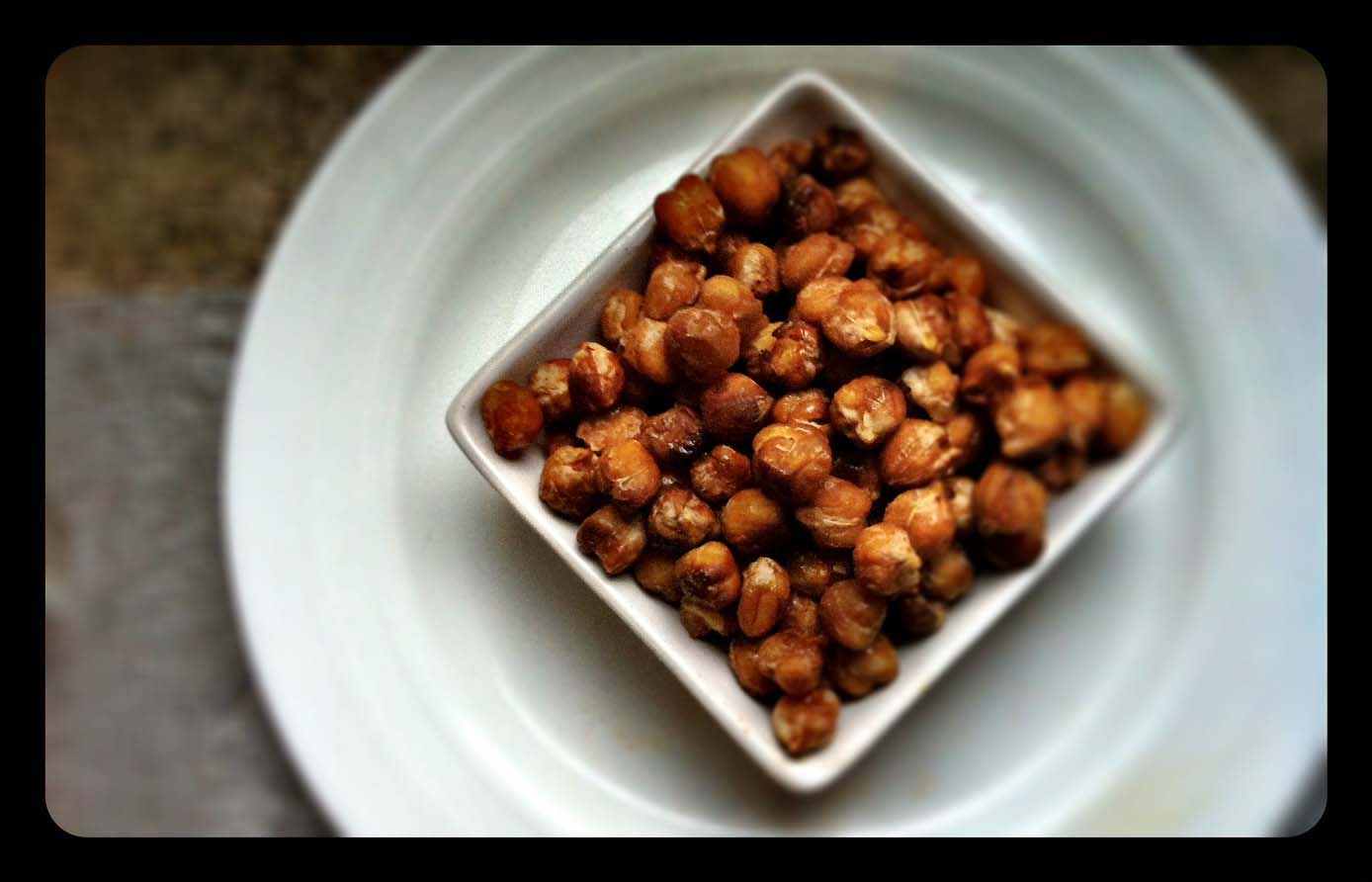
I know I have, because they usually just taste too good and are a quick healthy high protein snack to have around. Realistically though, I figured they should not be too hard to make and decided to see what Google had to say about the idea. I ended up downloading about half a dozen recipes from various sources, which when it came down to it were all pretty much the same except for the choice of spice mixture to use for flavoring the chickpeas. Some versions were sweet, some salty, some curried, and some with herbs, but I tend to like when savory and sweet are used together, which is why this recipe by Jerry James Stone for a Maple Seat Salt variation caught my attention. Another recipe used smoked paprika in the seasoning, and that got my brain thinking that maple, sea salt, and smoked paprika would make a really yummy flavor combination, and it did!!

Overall, they did not turn out quite as I had imagined. The seasoning was great, but the chickpeas themselves mostly either burned, or were too soft in the middle. There were very few on the tray that actually came out as crunchy as the ones you can buy from the store. Even not as crunchy as expected, they still made a great late morning snack, and would go quiet nicely with an after work beer (or 2). I will definitely have to try again experimenting with different flavor combinations, cooking times, and temperatures.

I wonder if roasting the chickpeas and then dehydrating them might be an easier way to go. Does anyone have a food dehydrator I can borrow?

Smokey Sweet Maple Chickpea Snacks

INGREDIENTS

  • 15 Ounces or 425g of cooked Chickpeas
  • 1 Tablespoon real Maple syrup (imitation Maple Syrup does not have the same depth of flavor)
  • ½ Teaspoon Brown Sugar
  • ½ Teaspoon Sea Salt
  • 1/4 Teaspoon  La Chinata Smoked Paprika

Preheat the oven to 180 degrees C.

Strain the chickpeas and rinse them clean.

Place a paper towel on a flat surface and spread the chickpeas on to it so that they are a single layer. Place another towel on top of them, rolling them around, until they are completely dry.

Add the seasonings to the chickpeas, and then place them on a baking sheet lined with parchment paper.

Roast them for about 40 minutes until they are a deep golden brown and very crunchy, making sure to not burn them.

ENJOY!!

Standard
100 Days Project, Baking, Cookies, Desert, Recipes

Day 12 – Snickerdoodle Cookies

Day12

Who wants a late night snack?

I actually really love baking at night. It is a fun and relaxing way to spend an evening. Plus, when finished, you have a sweet treat to go with a bedtime cup of tea, and something yummy to look forward to eating and sharing the next day (or even take over to a friend’s house for a late night cookie delivery).

Snickerdoodles are a cinnamon and sugar shortbread American classic.  If I remember correctly, they are one of the first things I ever learned for to bake myself. Although I probably have not made them is close to 20 years,  I was recently reminded of how much I enjoy Snickerdoodles when Moustache (the cookie bar in Auckland CBD) opened last year, and they had them on offer. So . . . I decided to look up a recipe for Snickerdoodles and added it to my must make soon recipe folder on my computer that I am trying to work my way through during this 100 Days Project challenge.

For the sake of this posting and pure curiosity, I tried looking up where the name Snickerdoodle came from. The best answer of course came from Wikipedia: ” The Joy of Cooking claims that Snickerdoodles are probably German in origin, and that the name is a corruption of the German word Schneckennudeln (snail noodles), a kind of pastry.  It is also possible that the name is simply a nonsense word with no particular meaning, originating from a New England tradition of whimsical cookie names.”  Personally, I prefer the second explanation.

Snickerdoodle Cookies

by: Baking Makes Things Better

INGREDIENTS

Cookies:

  • 2 ¾ cups all purpose flour
  • ½ teaspoon salt
  • 2 teaspoons baking powder
  • 1 cup unsalted butter, room temperature
  • 1 ½ cups granulated white sugar
  • 2 large eggs
  • 1 teaspoon pure vanilla

Coating:

  • ⅓ cup granulated white sugar
  • 2 teaspoons ground cinnamon

Preheat oven to 190°C and place rack in the center of the oven. Line two baking sheets with
parchment paper.

In a large bowl whisk together the flour, salt, and baking powder.

In the bowl of your electric mixer, with a hand mixer, or with a good ‘ol fashioned wooden spoon, beat the butter and sugar until smooth

Add the eggs, one at a time, beating well after each addition. Scrape down the sides of the bowl, and then add in the vanilla extract.

Add the butter/sugar mixture and the flour mixture together and beat until you have a smooth dough. If the dough is soft, cover and
refrigerate until firm.

Shape the dough into 2.5 cm or 1.5 inch round balls.

To coat:

In a large shallow bowl mix together the sugar and cinnamon. Roll the balls of dough in the cinnamon sugar and place on the prepared pan, spacing about 5 cm
apart. Then, using the bottom of a glass, gently flatten each cookie to about 1.5 cm thick.

Bake the cookies for about 10 – 15 minutes, or until they are light golden brown and firm around the edges. The centres of the cookies will still be a little soft. Remove from oven and place on a wire rack to cool.

ENJOY!!

Standard
100 Days Project, Dairy Free, Food, Gluten Free, Mains, Vegan

Day 11 – Roasted Garlic & Caramelized Vegetable Tostada

Day11

I had a friend staying with me from Wellington last night so I decided to make something a bit fancy . . .

Especially when that friend is following my Herbivore posts and after reading my Day 9 – World Gin Day French 75  post, he shows up on my doorstep with a bottle of very good gin. Houseguests that arrive with a bottle of good gin definitely deserve a special meal.

Being from the United States and growing up in South Florida, which has a large Latino population, Mexican food is one of my favorite types of food to make.  Although, this recipe I would consider more Modern Mexican, which brings up the question of what is actually the difference between Tex-Mex, traditional Mexican, and Modern Mexican food.

Tex-Mex originated with Tejanos, Texans of Mexican descent, as a mix of native Mexican and Spanish foods when Texas was part of New Spain and later Mexico. It became Americanized in the 20th century, when modern American processed foods (like yellow cheese), became cheap and readily available.  In the 1960s, Americanized Tex-Mex food became a popular cuisine, characterized by heavy use of shredded cheese, meat (particularly beef and pork), beans, shredded lettuce, fresh chopped tomatoes, big dallops of sour cream, the heavy handed use of chili, and wheat based tortillas. Dishes such as Texas-style chili con carne, chimichangas, burritos, nachos, and fajitas are all Tex-Mex inventions.

Alternatively, Mexican food is complex and uses subtle flavor combinations from native ingredients including tomatoes, squashes, beans, avocados, plantains, cocoa, cinnamon, vanilla, tropical fruits, and corn tortillas, as well as other forms of lime treated corn like atole, pozol, tamales, and sopes. Despite the introduction of wheat and rice to Mexico, the basic starch remains corn in almost all areas of the country.  Mexican food has a reputation for being spicy, but its seasoning can be better described as strong and flavorful; chili peppers being used for their flavors and not just their heat. Traditional Mexican food has a base of corn, beans, and chili using meat and dairy sparingly concentrating on the dishes other ingredients and flavors.

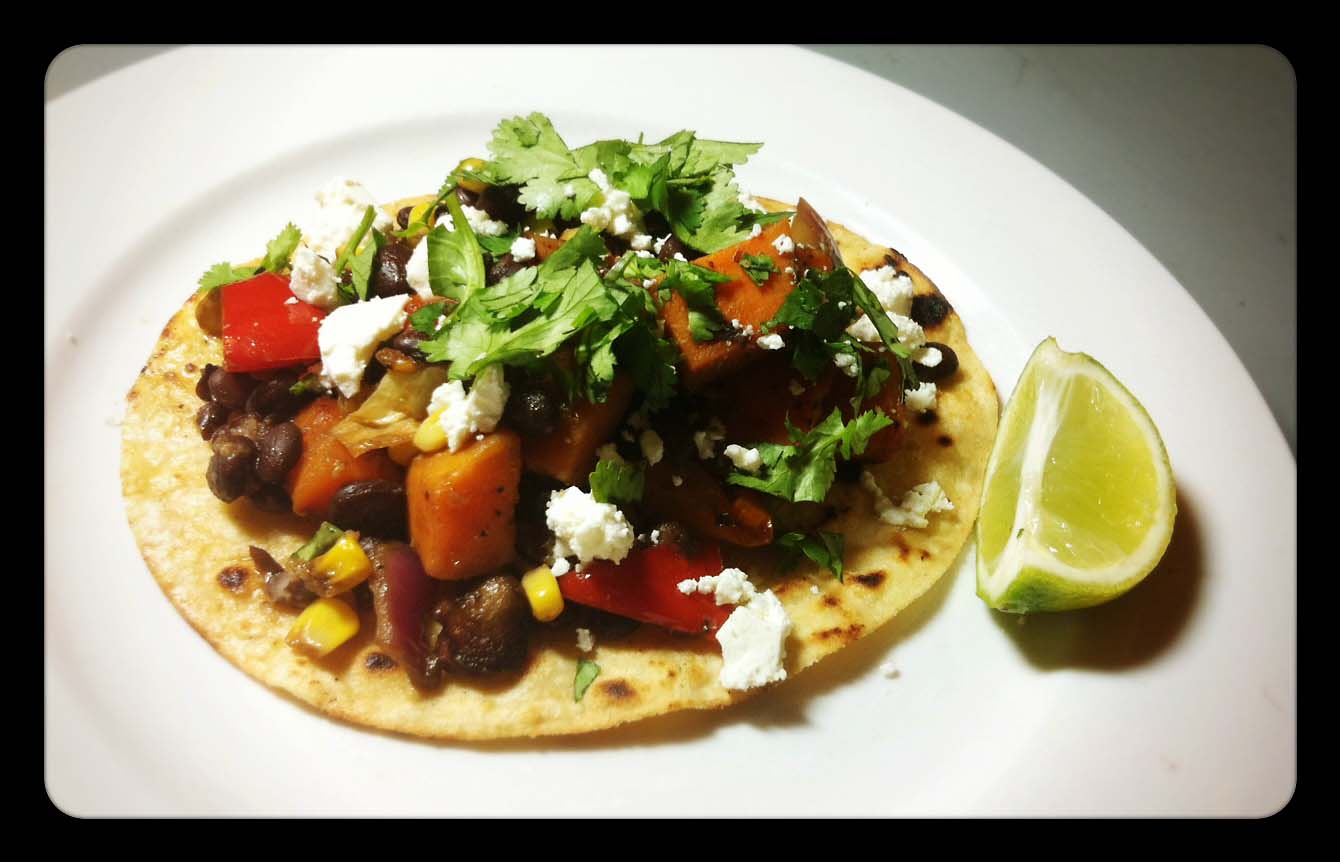
I consider this recipe for Roasted Garlic and Caramelized Vegetable Tostada to be Modern Mexican, as it combines ingredients and a type of dish that is traditional with popular contemporary western flavors like balsamic vinegar and roasted garlic. The original recipe from the How Sweet It Is blog, which typically focuses more on deserts and sweet treats than savory mains, calls for using shredded cheddar cheese and Greek yogurt or sour cream, but I chose to substitute the shredded cheese with cow’s milk feta (which is closer to traditional queso fresco) and leave off the Greek yogurt/sour cream, which I thought would drown out the more subtle flavors.

This recipe can easily be made dairy free and Vegan by leaving off the cheese.

Roasted Garlic & Caramelized Vegetable Tostada

adapted from: How Sweet It Is

MAKES: 4 tostadas

INGREDIENTS

  • 1 bulb of roasted garlic
  • 3 teaspoons olive oil
  • 1 small sweet potato, cubed
  • 1/2 red onion, chopped
  • 1/2 red pepper, chopped
  • 1/2 green pepper, chopped
  • 1 cup sliced mushrooms
  • 2/3 cup corn (if frozen, thaw and pat dry)
  • 1/4 teaspoon salt
  • 1/4 teaspoon pepper
  • 2 tablespoons balsamic vinegar
  • 2/3 cup black beans

for topping:

  • 1 avocado, chopped
  • 1/2 cup cow’s milk feta, crumbled
  • fresh cilantro/coriander
  • lime wedges

for base:

  • 4 corn tortillas
  • olive oil, for brushing

Preheat oven to 400 degrees F or 200 degrees C.

Line a baking sheet or grease the try with olive oil.

In a large bowl, combine sweet potatoes, peppers, onions, corn and mushrooms. Drizzle with 3 tablespoons of olive oil, then sprinkle with salt and pepper and toss to coat. Spread on a baking sheet and roast for 20 minutes. Toss vegetables with the balsamic vinegar, and roast for 15-20 minutes more until caramelized and sweet.

While veggies are roasting, heat a skillet over medium-high heat. Brush each tortilla (front and back) with olive oil, then place one at a time in the skillet until crisp and bubbly, being careful they don’t burn. Each tortilla should take about 5 minutes or so. Remove tortillas and place on a wire rack or plate to cool.

Return the balsamic roasted veggies back into the bowl, add in the black beans, and mix. Squeeze out the roasted garlic cloves and mix thoroughly into the vegetables.

Layer each tortilla with a big helping of the vegetables and garlic, then top with avocado,
cilantro/corriander, cheese and lime juice.

ENJOY!!

Standard
100 Days Project, Dips, Condiments and Dressings, Gluten Free, Party Food, Recipes, Vegan (with substitutions)

Day 10 – White Bean & Pea Shoot Crostini

Day10

Mmmmm . . . Crostini . . .

There is nothing quite like a piece of toasted chrunchy bread topped with an assortment of tasty ingredients. These little nibbles are perfect for a party, an appetiser/entree,  along side of a salad or bowl of soup, or even on their own with a beautiful glass Sauvignon Blanc or other tipple of your choice.

That being said, flavor wise, this probably has not been one of my favorite dishes I have made so far during the 100 Days Project. It tastes nice and full of spring flavors (like lemon and mint), but the inclusion of the raw pea shoots, which I enjoy in salads and sandwiches on their own, did not quite seem to work with the other ingredients.

Th original recipe called for Fava beans, which I could not find in New Zealand this time of year, so maybe the Cannellini Beans I used instead were lacking something to bring the flavors together.

But everyone is different, so if you like the sound of the recipe, give it a try . . . you never know, it could be your new favorite.

You can easily make it gluten free by using a different base for the toppings, and  make it dairy free by leaving off the cheese.

White Bean & Pea Shoot Crostini

adapted from: The Cozy Herbivore

PREP TIME: about 10 minutes
COOKING TIME: about 20 minutes
MAKES: about 24 crostini
INGREDIENTS:

for the bean spread:

  • 1 1/2 pounds or 1 1/4 cups cannellini beans
  • 2 tablespoons extra virgin olive oil
  • 2 ounces pea shoots, roughly chopped
  • 1 bunch or 1/2 cup loosely packed fresh mint, roughly chopped
  • 1 small bunch or 1/4 cup loosely packed fresh flat-leafed parsley, roughly chopped
  • the juice of 2 lemons (about 2 tablespoons)
  • sea salt and freshly cracked pepper, to taste
  • parmesan or manchego cheese, for garnish

for crostini:

  • 1  baguette, cut diagonally into 1/4″ slices
  • 1 clove garlic, roughly smashed
  • 1/4 cup extra virgin olive oil
  • a sprinkle of sea salt and a few cracks of the pepper mill

DIRECTIONS

Prepare the crostini:

Preheat oven to 350 degrees F or 180 degrees C. Lay baguette slices on a couple of baking sheets and rub smashed garlic clove on top of the bread. Lightly brush slices with olive oil and from, and sprinkle with sea salt and freshly cracked pepper.

Place in oven and bake until bread is uniformly a dark golden brown, checking often so the slices don’t burn.  This will take anywhere from 10-20 minutes. Remove slices as they brown and set aside. Crostini can be made up to two days ahead and stored at room temperature in an airtight container.

Prepare the bean spread:

Bring a large pot of salted water to a rolling boil. Add cannellini beans and boil till soft.  Drain and rinse
under cold water. Alternatively you can use a slow cooker to cook the beans, or you can use canned beans if you do not have dried beans around.

Place cooked beans, olive oil, pea shoots, 4. mint, parsley and lemon juice in the bowl of a food processor and pulse until a thick paste is created. (If mixture is super-chunky, drizzle a little more olive oil through the top of the food processor while it’s running until a
smooth consistency is reached.) Season to taste with sea salt & pepper.

The fava paste can be made up to a day ahead and stored in an airtight container in the fridge.

To assemble:

Spread 1 teaspoon of bean paste onto each crostini. Using a vegetable peeler, shave off long, thin slices of manchego or parmesan cheese to garnish.

ENJOY!!

Standard
Eco-Culture, sustainable business

The B Team

On Thursday night last week I went to the launch event for The B Team Challenge at the BizDojo, Auckland.

The B Team is a group of global business leaders, headed by Richard Branson and Jochen Zeitz, who have committed themselves to a mission: ” The B Team’s mission is to deliver a ‘Plan B’ that puts people and planet alongside profit”.  The 14 business leaders (click here to see their profiles) taking part in this challenge, realize that in order to create a sustainable future for business, there has to be a sustainable future for our planet and the people living on it.

I believe that business taking a leadership roll in creating sustainable practices is certainly a huge step in the right direction. When larger corporations or even small businesses make sustainability education and practice a priority and part of the workplace culture, this positive example can trickle down into everyday lives of the employees, their families, and the ultimate goal of creating positive change in our global society.

The B Team will address three initial Challenges of “The Future of Leadership”, “The Future Bottom Line” and “The Future of Incentives”, but they also realize that they might not have all the answers and are calling on the global community to add their input and ideas to this project: ” The B Leaders will focus on execution and action, catalysing and amplifying others’ efforts by undertaking specific global Challenges where their collective voice can make a difference”.  This global community includes a panel of advisors and partners, but it can also include you. After the initial launch, the B Leaders left 3 questions to start discussion amongst the individuals watching the live broadcast at kick-off events around the world.

  1. How might The B Team help amplify or catalyse what you are already doing in your organization as part of Plan B for Business?
  2. What are the most transformative, scalable and systematic solutions that can advance the three Challenges we have announced?
  3. As part of a Plan B for Business, we need to reflect on what the fundamental role of business is for people and the planet. If you could add one statement to a new “Charter” that redefines the purpose of business, what would it say?

If you have something to say concerning any of these 3 questions, or want to follow the developments of this project you can follow the Twitter feed @thebteamhq, #PlanB

Standard
Eco-Culture, Wind Energy

Global Wind Day

GWD

Hayes Wind Farm, Central Otago, New Zealand

It turns out that besides being World Gin Day, June 15th is also Global Wind Day.

Staring in 2007, Global Wind Day is s a worldwide event organized by The European Wind Energy Association – EWEA – and the Global Wind Energy Council – GWEC  that occurs annually on 15 June. It is a day for discovery and discussion around wind, its power, and the possibilities it holds as a sustainable energy resource for the global future.

More than 75 countries around the world have wind farms in operation generating energy from this clean and renewable source. In New Zealand, where the majority of power generation comes from renewable resources, wind farms have an installed capacity of 623 megawatts and generate over 4% of electricity for the country.
Comparatively in the USA, which has a much larger population and land mass, wind farms have a installed capacity of approximately 60,000 megawatts. You can download the 2012 GWEC Global Wind Report, which will give you a more comprehensive picture of the currant status of wind energy use in the world.

While there has been much controversy here in New Zealand, as well as the rest of the world, about the effectiveness of wind power generation versus the costs, both financially and aesthetically. I know personally I would much rather see a wind turbine on the horizon than a smoke stack billowing CO2 laden smoke, or risk contamination and exposure from a nuclear power plant leak.

kc_pinwheelWind power generation is is certainly an avenue that needs to continue being explored as fossil fuels are becoming more expensive, more scarce, and are are a continued detriment to the global environment. So . . . go grab a pinwheel (or even better, make one), and celebrate Global Wind Day!!

Standard