100 Days Project, Dairy Free, Gluten Free, Party Food, Recipes, Side Dish, Snacks, Vegan

Day 37 – Dolmades

Day37

Since I started off last night with my Day 36 Feta & Pesto Stuffed Peppadew Peppers post, I decided to keep up the theme for the weekend with recipes for small plate tapas type dishes. Dolmades seemed like the perfect fit!!

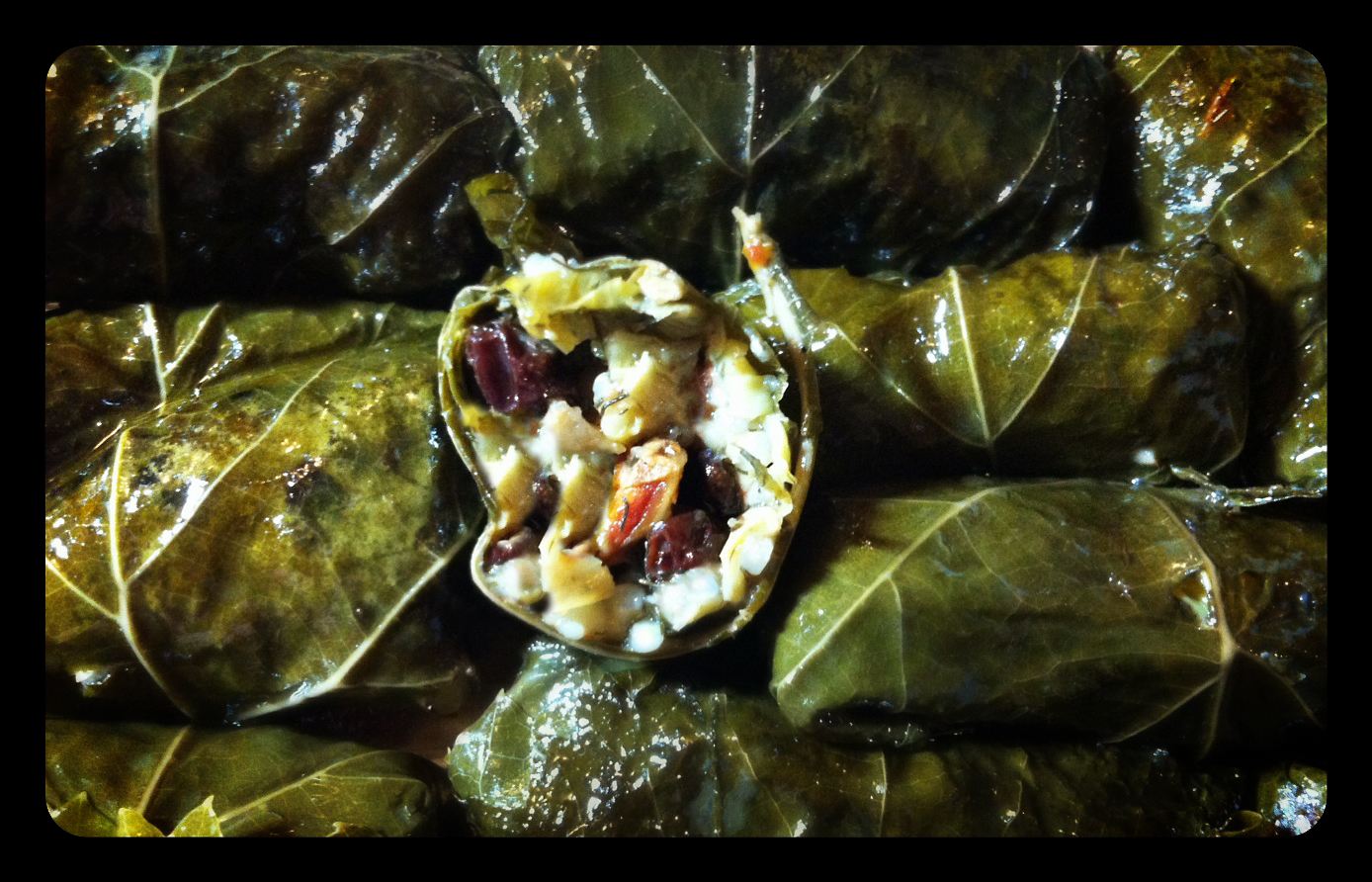
Dolmades or Dolma are a stuffed vegetable dish common in the Balkans and surrounding regions of the Middle East. The word Dolma comes from the Turkish for “stuffed thing”. Generally, grape or cabbage leaves are wrapped around a rice based filling, that can be meat or vegetarian, and includes onion, herbs like dill, mint or parsley and spices. While meat Dolma are served warm, vegetarian ones are often served cold or at room temperature. There are numerous variations of ingredients and fillings across the many countries that make a Dolma-like dish.

I first made and had Dolmades as a pre-teen at summer camp. Two kids from every cabin had to help out the kitchen staff with food prep every day. Probably not hard to believe that this was one of my favorite tasks on the chore rotation. I remember one day when we came in, there was a big industrial sized bowl of rice filling and all these grape leaves. I had never thought about eating an actual leaf before (not including lettuce) and thought this was a bit strange. I followed instructions on how to fill and roll the grape leaves into Dolmades, and was pleasantly surprised when it came to dinner time that this strange dish was actually quite yummy!! Although I have eaten Dolmades many times since then, this was probably the last time I tried making them myself until today.

Dolmades

adpated from: Kitchen Classics – Gourmet Vegetarian

MAKES: approx. 40 Dolma

INGREDIENTS

  • 6 spring onion (green onions)
  • 1/2 cup olive oil
  • 3/4 cup long grain rice
  • 15 grams or 1/2 ounce fresh mint
  • 2 tablespoons chopped dill
  • 2/3 cup lemon juice
  • salt and pepper, to taste
  • 1/4 cup currants
  • 1/4 cup sun-dried tomatoes, finely chopped
  • 1/4 cup artichoke hearts, finely chopped
  • 1/4 cup pine nuts, toasted.
  • 235 grams or 8 1/2 ounce packaged pickled grape leaves
  • 2 tablespoons olive oil, extra

Heat the oil in a medium sized sauce pan. Chop the spring onions and add them to the pan, cooking them over a medium heat for only one minute.  Stir in the rice, mint, dill, half the lemon juice, and salt and pepper to taste. Add 1 cup of water and bring to a boil, then reduce heat, cover, and simmer for 20 minutes.

Dry roast the pine nuts until they are toasted and golden brown.

Remove the lid, and fork through the currants, sun-dried tomatoes, artichokes, and toasted pine nuts. Cover with a paper towel, then the lid, and leave to one side to cool.

Gently rinse and separate the grape leave, then pat dry with a paper towel and trim any thick stems off with scissors.

Line the base of a 20cm or 8 inch pot with any torn of misshapen leaves. Choose the larger leaves for filling and sue the smaller ones to patch any gaps.

Place a leaf shiny side down, vein side up,  on a cutting board. Spoon a tablespoon of filling into the center of the leaf.  Bring in the sides, and roll up tightly from the stem end of the leaf. Place seam side down in the base of the leaf lined pot arranging them close together in a single layer.

Pour int he rest of the lemon juice, the extra oil , and enough water to just cover the top of the dolmades. Cover them with an inverted plate and some sort of weight to firmly compress the dolmades and keep them in place while cooking (I had trouble finding something for this, but a tin of canned vegetables might work). Cover with the lid, and bring the liquid up to a boil reducing it to a simmer for 45 minutes. Let them cool and serve at room temperature.

These would make a great side dish to go with my Lebanese Red Lentil Soup.

ENJOY!!

Standard
Food

It turns out there is an Australian Face Book group of foodies called Baking Our Blues Away dedicated to helping beat the winter blues by creating an annual day of goodwill.

On Monday 15th July 2013, everyone anywhere in the world is encouraged to take a moment and give someone they know or don’t know, be it a loved one, a work colleague or perhaps a stranger on the street, a bit of baked or handmade love.

Personally I think this is a fantastic idea!!

Come on Herbivores . . . Who wants to bake with me on Monday!?!

Link
Dairy Free, Gluten Free, Recipes, Soups, Vegan

Lebanese Red Lentil Soup

RedLentilSoup

This soup is one of my favorite easy recipes to make, and is great for a winter weekday, when you just want something simple, warm, and full of flavor.

The recipe, originally from the Allrecipes.com website posted by JENP1, is closest I have been able to come to my favorite red lentil soup served at Mezze Bar in Auckland CBD.  It was not originally a vegetarian recipe, but with the substitution of vegetable stock for chicken stock, and a few small tweaks of the spices, I do not think it has lost any of its flavor.

Red lentils, which are very high in protein, vitamins, and nutrients, are often used in Middle Eastern style cooking. Lentils were one of the first domesticated crops, but may have been eaten by humans almost 13,000 years ago. Red lentils contain a lower concentration of fiber than green lentils, but that means they cook up quicker and you do not need to soak them overnight.

This recipe originally calls for fresh coriander, which is typical in a Middle Eastern dish, but I forgot to buy this ingredient at the store, so substituted with fresh chives. It still tasted nice, but would recommend going with the coriander for authenticity, if you have the option.

Lebanese Red Lentil Soup

adapted from: JENP1, Allrecipes.com

SERVES: 6-8

INGREDIENTS

  • 6 cups vegetable stock
  • 450 grams or 1 pound  red lentils
  • 3 tablespoons olive oil
  • 1 tablespoon minced garlic
  • 1 large onion, chopped
  • 2 tablespoons ground cumin
  • 1 tablespoon of ground coriander
  • 1 tablespoon of black pepper
  • 1/2 cup chopped coriander
  • 3/4 cup fresh lemon juice

Bring vegetable stock and lentils to a boil in a large soup pot over high heat, then reduce heat to medium-low, cover, and simmer for 20 minutes.

Meanwhile, heat olive oil in a skillet over medium heat. Stir in garlic, onion, and spices and cook until the onion has softened and turned translucent, about 3 minutes.

Stir onions into the lentils, and continue simmering until the lentils are tender, about 10 minutes.

At this point if you are in a hurry, you can puree the soup in a standing blender or with a stick blender to get a smooth consistency, but I prefer to turn down the heat to low and let it continue to simmer for another 10-15 minutes, and the lentils will break down themselves.

Stir in the fresh coriander and lemon juice before serving, and garnish with feta cheese and a bit more coriander. Leave off the cheese if you want to keep this soup Vegan.

ENJOY!!

Standard
Gluten Free, Raw, Recipes, Salads, Vegan (with substitutions)

Antipasto Salad

Antipasti Salad

I love antipasti plates!!

Antipasto means “before the meal” and is the first course of a formal Italian dinner. Now, I know traditional antipasti plates have cured meats on them as well, but personally I say “who needs it” when you have all sorts of yummy pickled and marinated vegetables with different kinds of cheeses thrown in for good measure. The contents of a traditional Italian antipasto vary greatly according to regional cuisine, and this salad is something you can easily vary according to your own tastes..

This Antipasto Salad is something I threw together to go with an Italian dinner I was making years ago, and have continued making it ever since. I do not think I have ever made it exactly the same way twice; there is plenty of room for your own experimentation, but the basic idea is always the same.  In this version I used a combination of spinach, rocket (arugula), and fresh basil leaves as the greens, with artichokes, sun dried tomatoes, capers, peppadew peppers, and pan fried haloumi on top, but marinated mushrooms, cocktail onions, olives, roasted red peppers, pepperoncinis, marinated garlic,  fresh mozzerella, parmesan, feta or numerous other marinated or pickled vegetables and fresh cheeses are all other options.

None of the measurements below are exact, it all depends how much of  the different ingredients you want to add to your salad. This salad can be made vegan, by leaving off the cheese and it still has plenty of flavor.

Antipasto Salad

SERVES: 4

INGREDIENTS

  • 1 bag of baby spinach
  • 1/2 a bag of rocket (arugula)
  • a large handful of fresh basil leaves
  • 2 -3 marinated artichoke hearts, chopped
  • 1/2 cup sundried tomatoes, chopped
  • 1/2 cup peppadew peppers, chopped
  • 1/4 cup capers
  • 1 packet haloumi
  • olive oil

for the dressing

  • 1/2 cup good quality olive oil
  • 1/4 cup balsamic vinegar
  • 1 tablespoon dried mixed italian herbs
  • pinch of dried chili flakes
  • salt and pepper to taste

Mix your greens together in a large bowl.

Roughly chop your marinated and pickled vegetables, and add them into the bowl along with the capers.

Add your cheese and dressing on top of the salad.

If using haloumi: On a medium high temperature, heat enough olive oil to cover the bottom of the pan. Cut the haloumi into 5mm or 1/8 inch slices and add them to the pan, once the oil has been heated. Let the cheese brown on each side for about 2-3 minutes. If your haloumi looks like it is starting to melt, you probably have your heat too high.Let the cheese cool slightly but add to the salad and serve still warm.

For the dressing: Mix all the ingredients in a small bowl with a whisk or fork until they looked combined.

ENJOY!!

Standard
100 Days Project, Gluten Free, Party Food, Recipes, Snacks

Day 36 – Feta & Pesto Stuffed Peppadew Peppers

Day36

Make your own tapas . . .

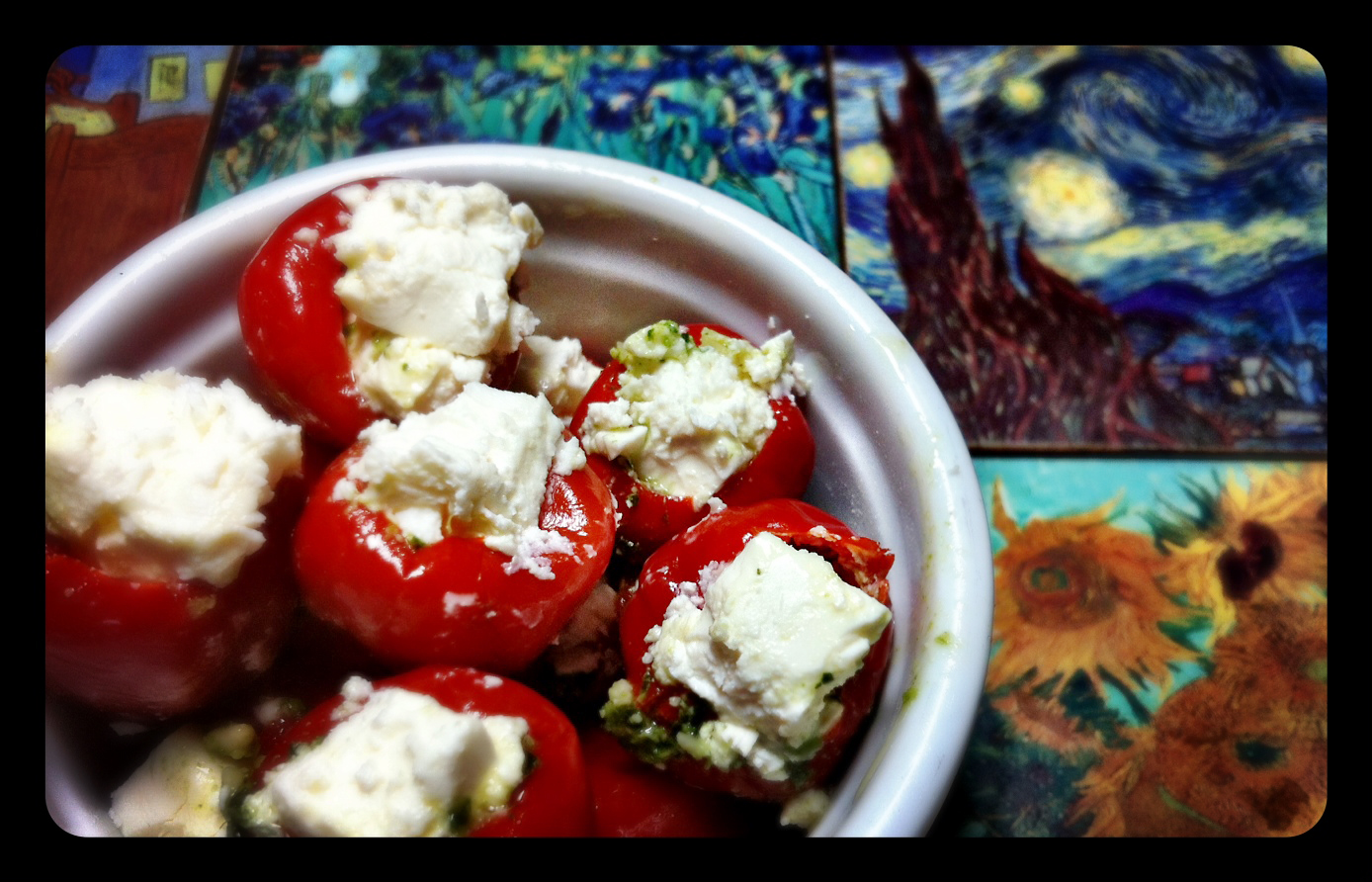
I first had feta stuffed Peppadews at a friend’s wedding and I have been hooked on these little sweet and slightly spicy treats ever since, but this is the first time I have ever made them myself. Normally, they can be found in the deli section of the supermarket, where you pay a ridiculous price for the convenience of having someone else stuff a little square of feta into the Peppadew for you because you can not be bothered to take the time and do it yourself.  No more . . . I will henceforth be making my own feta stuffed Peppadews with the Herbivore twist of adding a small dallop of pesto at the bottom of the pepper before stuffing it with feta.

Just like Kleenex or Hoover, Peppadew is actually a brand name for a certain type of sweet piquanté peppers originally grown in South Africa. The pepper is processed for removal of the seeds and reduction of the spiciness of the pepper to more tolerable levels. It is then pickled and bottled. The flavor of a Peppadew is sweet with a slight briney spice.

Feta & Pesto Stuffed Peppadew Peppers

INGREDIENTS

  • 1 bottle Peppadew peppers
  • 1 package feta cheese
  • 1 tub of pesto or make your own fresh

Drain the brine from the jar of peppers.

Cut the feta cheese into small squares.

Using a teaspoon, place a small amount of pesto at the bottom of the Peppadew and then stuff it with the small block of feta. Do not worry of some of the pesto gushes out around the edges. Continue the same process with each pepper until you have finished the bottle, or alternatively run out of either pesto or cheese.

ENJOY!!

Standard
100 Days Project, Mains, Recipes

Day 35 – Vegetable & Egg Quiche with a Rye Crust

Day35

I was having a few friends over for dinner tonight and wanted to make something a bit special.

I had this recipe for a vegetable pie, from Krisser’s Cookie Crumble blog, in my collection,  and it looked so beautiful with the spiral of vegetables that I really wanted to try it. I had given the recipe a quick scan, but did not realize until after I started making it; that the recipe was translated very badly (I think the original is in Danish). Oh well . . . I had already started and told my guests this was what we were having for dinner, so had to keep with it and do the best I could.

The first obstacle I ran into was that the translated recipe did not call for enough liquid to bind the flours for the crust together. So I had to do a bit of experimentation slowly adding more water and oil until a got a crust that would hold. Even then, it kind of fell apart while transferring the pie crust to my tin and I had to piece it back together.

The thing that makes his recipe spectacular is the way the vegetables are sliced and used standing on edge to create a pattern. The original recipe had all the slices beautifully curved into circles. As you can see from the image above, my vegetable slices did not quite want to conform to a circular shape, and ended up more triangular. I think the vegetables in the original recipe must be sliced using a mandolin vegetable slicer, but unfortunately this is a kitchen gadget I do not own and I could not cut my vegetables thin enough by hand to easily hold the circular shape. If you have a mandolin, I would definitely suggest using it.

I also substituted the the milk the recipe called for with left over mascarpone cheese from my Day 33 post, Gnocchi with Tomato Mascarpone Sauce,  and thought the egg could use a little favor of its own and added my favorite go to herb, dill. I never did meet a recipe I didn’t want to tweak. Even with the problems and the changes, this made a delicious main for my meal tonight, was enjoyed by all, and I will definitely have to refine the recipe and give it another try. The recipe posted below includes the changes and tweaks I made to the original recipe.

Vegetable & Egg Quiche with a Rye Crust

adapted from: Krissers Cookie Crumble

INGREDIENTS

for the crust

  • 90 grams or 3 ounces of wheat flour
  • 200 grams or 7 ounces of rye flour
  • 6-8 tablespoons of cold water
  • 4 -6 tablespoons olive oil
  • 1 teaspoon salt

for the filling

  • 3 carrots
  • 4 small zucchini
  • 4 eggs
  • 4 tablespoons milk or mascarpone cheese
  • 2-3 teaspoons dill
  • salt and pepper to taste

Preheat the oven to 200 degrees C or 400 degrees F.

Grease a 20 cm pie dish or quiche pan.

Mix all five ingredients for the crust together until the dough becomes “crumbs”. Turn “crumbs” out on the table and knead them into a complete and cohesive dough. If it does not seem like the dough is sticking together slowly add more water and oil until it has the proper consistency.  Roll out the dough on the table to fit your pie dish and transfer the dough to your pie pan. If it falls apart like mine did, just piece it back together inside the pan; it gives your crust a more “rustic” look.. Now use your fingers to adjust the dough completely, so that it reaches all the way up over the edge of the pan.

To make the filling, peel the carrots and cut them and the zucchini into thin strips about the same height as your pie pan.  It might be easier to use a mandolin vegetable slicer for this. When the vegetables are ready Beat the eggs together with the milk or mascarpone. Add the dill and salt and pepper as needed.

To make the pie filling, place the strips of vegetable, end to end, all the way around the pie pan edge. Alternate between squash and carrot until you reach the middle, where a vegetable
strip rolled together creates the center. When all the vegetables are placed, slowly pour egg mixture gently between the vegetable layers. Try to make sure the egg mixture is evenly distributed, and that it comes down between the slices of vegetable.

Bake the pie for approx. 30 minutes.

Serve the pie warm, along with a good salad. My Antipasto Salad recipe made an excellent accompaniment for this pie.

ENJOY!!

Standard
100 Days Project, Gluten Free, Recipes, Salads, Vegan (with substitutions)

Day 34 – Roasted Shallot, Beetroot, & Lentil Salad

Day34

With all the heavy carbs I have been making lately, I felt like something simple green and leafy for dinner tonight.

Winter is always a good time for roasted vegetables, and combined with the fresh baby spinach and a tangy mustard based dressing this recipe for Roasted Shallot, Beetroot, and Lentil Salad, from the Hub-UK website, was exactly the kind of meal I was craving.

I have found many people do not know what a shallot is. This vegetable belongs to the same family as onions and garlic, and is thought to have originated in Central or Southeast Asia. Like garlic, shallots form in clusters with a head composed of multiple cloves. Shallots are used in many different cuisines from around the world. They taste somewhat similar to an onion, but have a milder flavour.

You can easily make this recipe Dairy Free  and Vegan by leaving off the cheese.

Roasted Shallot, Beetroot, & Lentil Salad

adapted from: Hub-UK

SERVES: 4

INGREDIENTS

  • 12 shallots, peeled (If large, cut in half)
  • 2 tablespoon rapeseed or olive oil
  • Sea salt and freshly ground black pepper
  • 250 grams or 9 ounces of beetroot, cooked
  • 1 tablespoons honey
  • 225 grams or 8 ounces cooked puy lentils
  • 150 grams or 6 ounces baby spinach leaves, washed and well drained
  • 200 grams or 7 ounces soft goat’s cheese

For the dressing:

  • 1 clove garlic, peeled and finely chopped
  • 1 tablespoon of chopped chives
  • 5 tablespoon rape seed or olive oil
  • 2 teaspoons Dijon mustard
  • 2 teaspoons cider vinegar
  • Sea salt and freshly ground black pepper

Preheat oven to 190°C or 375°F

Put puy lentils into a medium pot of boiling water and cook until done. Drain the lentils and rinse under water and place in a bowl.

If using fresh beetroot, chop into large pieces and put into a pot of boiling water. Cook for about 10 minutes or until the beetroot is mostly cooked.

Put the shallots into a roasting tin, drizzle with the 2 tablespoons of oil, toss well and season with sea salt and black pepper.  Place roasting tin in the oven for 15 minutes, then add the beetroot and drizzle with honey and toss well with the shallots. If using solid honey, put it in the microwave first for about 20 seconds to make the honey runny and easier to coat the vegetables.  Roast for a further 10 minutes, or until the shallots are soft.

To make the dressing, mix all of the dressing ingredients together and season with sea salt and black pepper.

When they are ready remove the shallots and beetroot from the oven and mix with the lentils and half the dressing while still warm and leave to cool.

To serve: Place  a large handful of spinach leaves onto a plate, top with the shallots, beetroot and lentils. Crumble the goat’s cheese on top, and drizzle with some of the remaining dressing.  You can serve this on its own, or with a hunk of crusty bread and a glass of medium bodied red wine.

ENJOY!!

Standard
100 Days Project, Mains, Recipes

Day 33 – Homemade Potato Gnocchi with Tomato Mascarpone Sauce & Fried Capers

Mmmmm . . . Gnocchi . . .

Gnocchi are one of those foods that are amazing to eat when made right, and for whatever reason are so often done wrong.  It is so disappointing to order gnocchi at a restaurant expecting little fluffy, melt in your mouth, pillows of potato goodness, and what is delivered on your plate are gluggy, sticky potato rocks.

Because it seemed too hard and daunting a task to make gnocchi that are nice to eat, I had never tried making my own . . . until now. My friend Stef claims she has a fool-proof easy recipe for potato gnocchi given to her by an Italian friend, Elisa Testoni, who used to run Italian cooking classes in Christchurch and now has moved back to Italy to open her own bed & breakfast (I know where I am staying next time I am in Italy).

So . . . I enlisted Stef’s help to make gnocchi for Day 33 of my 100 Days Project. Gnocchi are thick, soft Italian dumplings; the origin of which dates back to ancient Roman times. Originally made from semolina flour, modern gnocchi are most often made from potato, but ingredients vary depending on the region a particular recipe is from.  Traditionally gnocchi are eaten as a first course commonly served with melted or browned butter with sage, pesto, and other various sauces.

Mascarpone is a thick spreadable Italian cheese made from cream. It is considered a specialty of the Lombardy region of Italy and is used to thicken sauces and risottos, and is also used in deserts like Tiramisu. For this recipe the macarpone is added to tomato sauce to give it a creamy texture and flavor. On its own, I thought the combination of tomato and mascarpone would be delicious, but I like to have a little texture and saltiness with creamy sauces. A friend had recently been talking about frying capers, and how they “pop in your mouth with a crunch releasing that yummy warm salty brine”. From this description, I thought fried capers would make the perfect finishing touch for my plate of gnocchi and sauce.

Instead of being a single recipe, this dish for Day 33 is more of a combination of food elements that I have been wanting to try. The gnocchi, the sauce, and the fried capers originally come from three different recipes or ideas I have heard about. Together, the three different elements create a quite tasty meal.

Homemade Potato Gnocchi with Tomato Mascarpone Sauce & Fried Capers

MAKES: 3 servings

INGREDIENTS

for the gnocchi

  • 600g potato
  • 200 g plain flour or semolina flour
  • 1 egg, lightly beaten
  • 2 tablespoons parmesan, finely grated
  • 2 teaspoons nutmeg (freshly grated is best but not necessary)

for the sauce – recipe adapted from BBC Good Food.

  • 1 tablespoon olive oil
  • 2 garlic cloves, crushed
  • 400 gram or 14 ounce can of chopped tomatoes in sauce
  • 140 grams or 5 ounce mascarpone
  • 200 gram or 8 ounce bag of baby spinach
  • handful fresh basil leaves
  • shaved parmesan, for garnish
  • salt, pepper, and Italian herbs to taste

for the capers

  • 1/2 cup capers, drained and patted dry

For the gnocchi: Boil potatoes with skins on.  When cool enough to handle remove potato skins with your thumbs.  Mash the potato and let completely cool. This is best prepared ahead of time so that the mashed potato can completely cool, but can be put in the refrigerator or freezer to save time.

Add the lightly beaten egg, flour, and parmesan. Do not add these ingredients until the potato has completely cooled or else your gnocchi will come out sticky and gluggy instead of light and fluffy.

On a lightly floured surface, knead the ingredients into a smooth dough, and then pad it out into a shape about 20mm or 1 inch thick.

Cut the dough into strips about 20mm or 1 inch wide. Roll the strip back and forth until rounded, and then cut into 30mm or 1 1/2 pieces. With the back of a floured fork give the gnocchi pieces grooves.

Place gnocchi pieces on a floured baking sheet to rest.  At this point, if you are not planning on eating all the gnocchi right away, the gnocchi pieces can be put into the freezer for use at a later date.

While gnocchi are resting, fill a large pot with water and salt, and bring the water to a boil. Once the water is boiling, put the gnocchi pieces into the pot making sure to stir the water so that they do not stick together. If you are using gnocchi that have been frozen from before, then they can come directly out of the freezer and into the pot of boiling water. Bring the water back up to a gentle boil, and when the gnocchi float to the surface they are done.  Use a slotted spoon to transfer the cooked gnocchi from the pot into a colander or plate.

For the sauce: Heat the olive oil in a frying pan, fry the garlic until golden, then add the tomatoes. Season, with salt and pepper or other Italian herbs, and then let simmer for 10 minutes.

Stir in the mascarpone and cook for 2 minutes more.  Add the spinach for the final min of cooking. You want to make sure the spinach is just wilted and not over cooked into the sauce.

For the capers: Drain the capers of any brine and pat dry with a paper towel.

Heat the oil in a small heavy duty skillet over a medium heat. Add capers to oil in the skillet and fry until capers are crisp and open like flowers. Stirring often, they will need to cook for only 45 to 60 seconds.

Using slotted spoon, transfer capers to paper towels to drain. The capers can be fried two hours ahead before being used in a recipe. Just let them stand at room temperature until you’re ready to add them.

To serve: Add cooked gnocchi into the pan of sauce and mix well. Serve immediately with basil leaves, parmesan shavings, and fried capers scattered over the top of each portion.

ENJOY!!

Standard
100 Days Project, Baking, Cakes, Dairy Free, Gluten Free (with Substitutions), Recipes

Day 32 – Mexican Hot Chocolate Cake

Day32

Today is my friend’s birthday, and birthdays mean cake  . . .

This particular friend happens to be both Gluten and Dairy Free, which does make baking a birthday cake a bit of a challenge. Luckily, I found this recipe for Mexican Hot Chocolate Cake, from Dish magazine, in my collection of untried recipes. Besides being quite yummy, with a few simple substitutions I could easily make it fit her dietary restrictions.

The main flavors of this cake are chocolate, chilli, and cinnamon, mimicking the traditional Mexican way of making hot chocolate with these spices.  Ancient Aztecs cultivated chocolate for eating and drinking, and the combination of dark chocolate and chilli dates back to their civilization. Hot chocolate was originally created by the Aztecs by roasting cocoa beans, and then using a mortar and pestle to grind the roasted cocoa beans with water.  They flavored this drink with chilli, vanilla, honey and pepper.  Cocoa beans quickly became a desired crop for the European settlers once  they tasted this delicious drink. In the modern westernized world, chilli and chocolate is once again becoming a popular combination amongst us “foodies”.

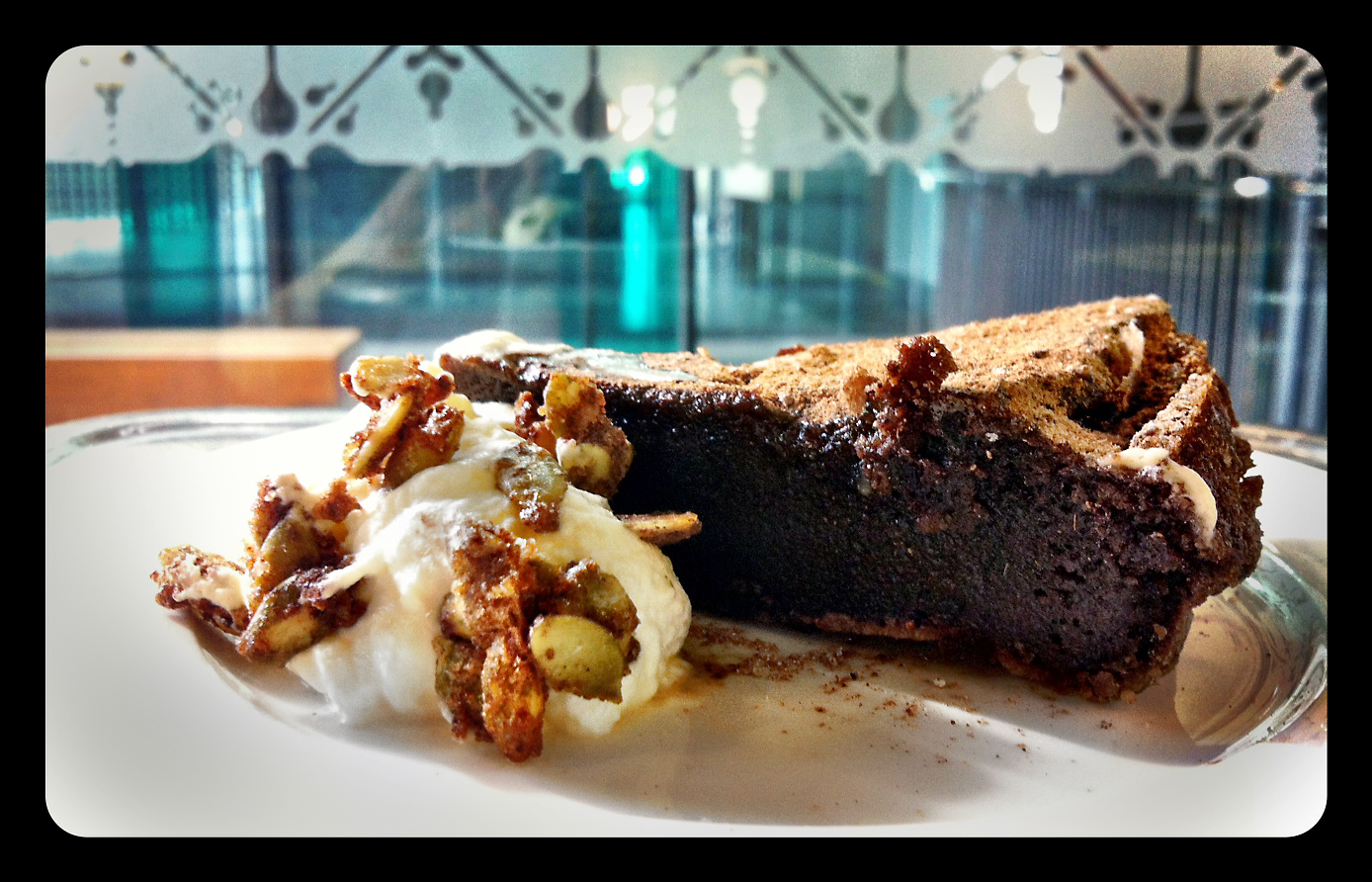
This recipe makes a very rich, almost pudding like cake, that when topped with candied pumpkin seeds and vanilla whipped cream (the birthday girl skipped this part) made a lovely mid morning birthday treat.

Mexican Hot Chocolate Cake

adapted from: Dish magazine

MAKES:8 -10 servings

INGREDIENTS:

for the cake

  • 200 grams or 7 ounces of butter or butter substitute like Olivani
  • 200 grams or 7 ounces of dark chocolate, chopped
  • 1 cup castor sguar
  • 1 teaspoon vanilla extract
  • 4 eggs, lightly beaten
  • 2 tablespoons plain flour or brown rice flour for a gluten free alternative
  • 1/2 teaspoon sea salt
  • 1 teaspoon ground cinnamon
  • 1/4 teaspoon ground cayenne pepper
  • 1 tablespoon icing sugar, for garnish
  • 1/2 teaspoon cocoa powder
  • 1/2 teaspoon cinnamon

for the vanilla whipped cream

  • 1/4 cup heavy cream
  • 1 teaspoon vanilla extract

for the candied pumpkin seeds

  • 1 egg white
  • 1/4 cup castor sugar
  • 1/4 teaspoon ground cinnamon
  • 70 grams or 2.5 ounces of pumpkin seeds

Preheat the oven to 170 C or 340 F

Grease a 20cm (8″) cake tin, and line it with baking paper.

Melt the butter and chocolate in a heat proof bowl set over a pan of simmering water, stirring occasionally, or in a double boiler.  If using the bowl, do not let the water touch the base of the bowl or the chocolate will seize.

Stir int he sugar and vanilla and leave the chocolate to cool, for about 10 minutes.

While chocolate is cooling, put all the ingredients for the candied pumpkin seeds into a bowl and combine well with a fork. Do not beat the egg white until frothy.

Spread seed and spice mixture evenly on a lined baking tray and bake for 5-6 ,minutes, turning once during baking.

The seeds will be sticky when you turn them, but well become crunchy when cooled. break seed sup into pieces once it has completely cooled.

Once the chocolate has cooled, stir in the eggs, and then fold in the  flour, salt, cinnamon, and cayenne pepper.

Pour mixture into the greased cake tin making sure the top is smooth. Bake for 20 – 25 minutes, until the center is set, but not too firm. This actually took about twice that time in my oven. Just make sure the cake has risen and a knife in the center comes out clean.

Transfer to a rack and let cool completely in the tin, where the cake will deflate and set.

To serve: Whip the cream and vanilla to soft peaks. Remove the cake from the tin and gently peel off the baking paper. Place on a serving plate and dust with the combined icing sugar, cinnamon, and cocoa powder. Serve with a dallop of cream and a sprinkling of the candied pumpkin seeds.

ENJOY!!

Standard
Baking, Breads, Dairy Free, Vegan (with substitutions)

New York Style Bagels

Bagels

Today is Bagel Day at my flat!!

Honestly, it’s very difficult to find a proper bagel in New Zealand . . . I am sorry Kiwis, but a bread roll with a hole in the center just does not count!! A few years ago, I was rescued from this bagel wasteland by my friend Stephen, who had a bagel recipe from his sister, who lives in New York, and she originally got the recipe from a Rabbi’s wife. Now that has to be a good bagel recipe!!

Ever since then, Bagel Day was born . . . which just means that a few times a year I spend a Sunday morning making bagels and inviting people around for an afternoon of bagel indulgence. I have been told it is a life changing experience for most of my Kiwi friends.

Bagels were invented by the Jewish population of Kraków, Poland in the early 1600’s.  It is believed that bagels were the Jewish version of the obwarzanek, a lean bread of wheat flour designed for Lent.  Since then, the bagel became a staple of the Polish diet, as well as the diets of people in neighboring countries.  The name may have originated from an old spelling of the Polish word for bow, because traditional handmade bagels are not circles but slightly stirrup-shaped instead.  In the Brick Lane district and surrounding areas of London, England, bagels have been sold since the middle of the 19th century, and bagels were brought to the United States by immigrant Polish-Jews.  Father and son, Harry and Murray Lender, helped to popularize the bagel throughout North America in the 1960s by pioneering automated production and the distribution of frozen pre-sliced bagels.

The thing most people miss when making bagels, is that bagels should be briefly  boiled before they are baked. This gives the dough a thin skin, that when baked, becomes a crunchy outer shell for the soft bagel center. It does take a good chunk of time to go through all the steps of making your own bagels, but it makes a great social activity to do with kids or friends, and you wind up with a warm yummy treat.

The main problem with Bagel Day is I always end up eating way too many fresh out of the oven bagels and spend the rest of the Sunday in a bagel coma on the couch. Just remember . . . you have been warned!!

This recipe can easily be made Vegan by using an egg replacer.

New York Style Bagels

MAKES: between 20 – 40 bagels, depending on how big you make your bagel shapes (the recipe can be easily halved)

INGREDIENTS

  • 12 cups flour
  • 2 eggs
  • 2 tablespoons oil
  • 4 cups luke-warm water
  • 1 packet or 6 teaspoons dried yeast
  • 4 teaspoons salt
  • 1/4 cup sugar

Combine sugar, salt, oil, half of the flour, all liquid, yeast and eggs in a large bowl and mix with wooden spoon until smooth. Cover with tea towel and leave in a warm place for 30-45 mins until risen and bubbly. If you do not have a hot water cupboard or similar suitable warm place, then briefly turn on your oven to its maximum temperature and then turn off again. This will create a perfectly warm environment for your dough to rise in.

Beat in remaining flour and knead until smooth and elastic. Put dough into floured bowl, sprinkle a little flour on top, cover with towel and return to the warm place for 1 to 1.5 hours. If using your oven, you may want to turn it on briefly again, but remember to turn it off again. The dough should double in bulk.

Punch dough down and form your bagel shapes. The easiest way to do this is to take a round ball of dough, slightly larger then a golf ball, and pinch it in the center with your thumb and second finger. Insert the first finger of both hands into the hole created by the pinch, and twirl fingers in a circular motion smoothly expending the hole. Make the hole a little larger than you will need, as it will start to close up when the dough rises.  Try to make the surface of your bagel shapes as smooth as possible.

Place bagel shapes on a floured bench space, cover, and leave for 15 minutes to rest and rise slightly.

Now, heat your oven to 220 C or 425 F.

Drop bagels into a pot of slowly boiling salted water one at a time. Leave for about 30 seconds on each side (the longer you boil the bagels the thicker the skin will be). Remove bagel shapes from the pot and place onto oiled baking trays.

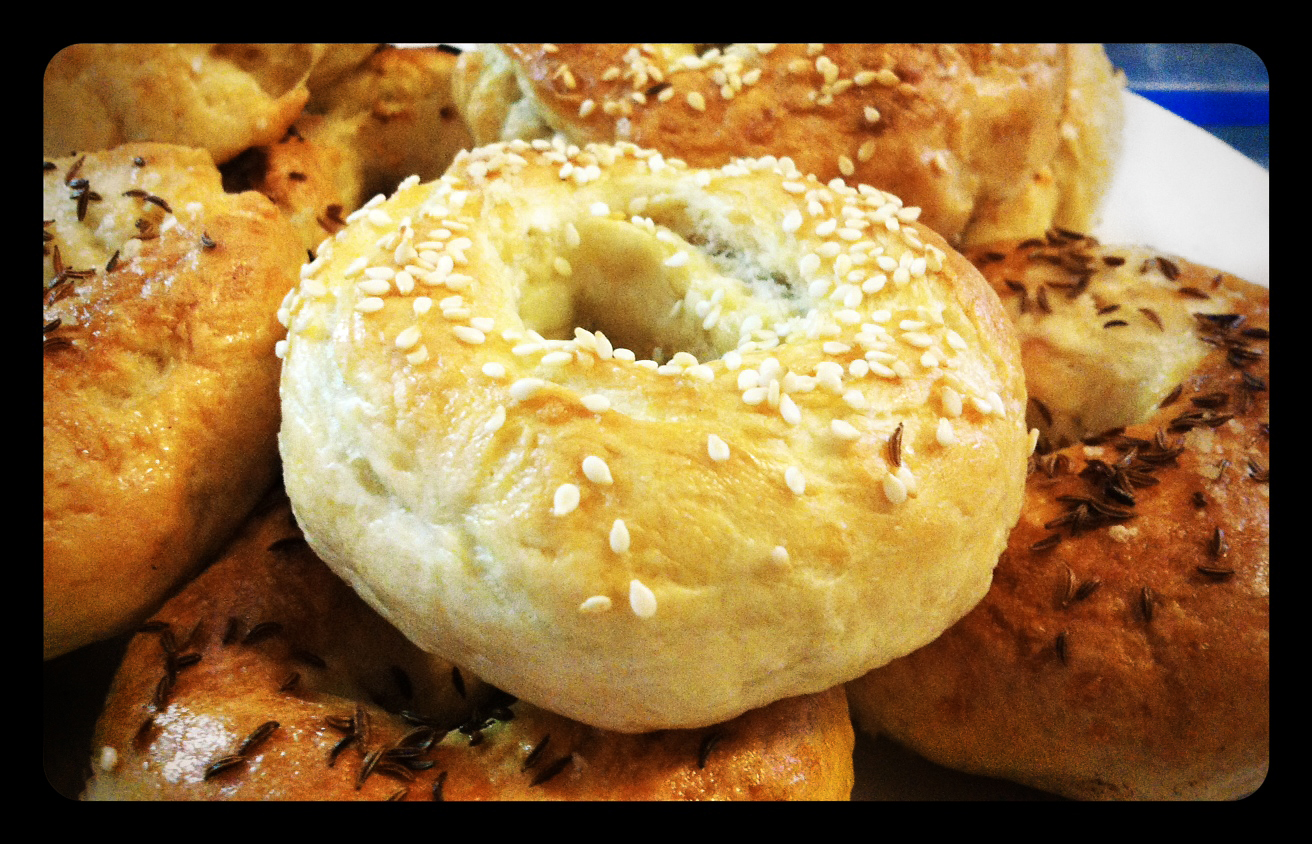
Sprinkle on your choice of toppings: garlic, onion, sea salt, rosemary, sesame seeds, poppy seeds, cinnamon and sugar, pepper, caraway seeds are just some suggestions. This is where you can be creative and experiment with topping combinations and flavors.

Bake for about 20 minutes or until brown.

Cool them on a rack or threaded on a wooden spoon handle to prevent sogginess.

Eat them as soon as they are cool enough to hold in your hand. My preference is slathered with a “shmear” of Philadelphia brand cream cheese, but you can get just as creative with your condiments and bagel sandwich making as you can with the toppings themselves.

Make sure to eat them while fresh, within 12 hours, the crust will have gone soft, and the texture from cakey to rubbery.

ENJOY!!

Standard